National
For national reports prior to 2023-24, please visit the Report Library.
NCI-IDD 2023-24 In-Person Survey National Report Table of Contents
2023-24 In-Person Survey (IPS) National Report: Demographics
2023-24 In-Person Survey (IPS) National Report: Employment
2023-24 In-Person Survey (IPS) National Report: Community Inclusion and Belonging
2023-24 In-Person Survey (IPS) National Report: Choice and Decision-making
2023-24 In-Person Survey (IPS) National Report: Community Participation
2023-24 In-Person Survey (IPS) National Report: Relationships
2023-24 In-Person Survey (IPS) National Report: Satisfaction
2023-24 In-Person Survey (IPS) National Report: Self-Direction
2023-24 In-Person Survey (IPS) National Report: Service Coordination
2023-24 In-Person Survey (IPS) National Report: Workforce
2023-24 In-Person Survey (IPS) National Report: Access
2023-24 In-Person Survey (IPS) National Report: Safety
2023-24 In-Person Survey (IPS) National Report: Health
2023-24 In-Person Survey (IPS) National Report: Medications
2023-24 In-Person Survey (IPS) National Report: Wellness
2023-24 In-Person Survey (IPS) National Report: Rights and Respect
State
For state reports prior to 2023-24, please visit the Report Library.
- 2023-24 Alabama In-Person Survey (IPS) Report
- 2023-24 Arkansas In-Person Survey (IPS) Report
- 2023-24 Colorado In-Person Survey (IPS) Report
- 2023-24 Connecticut In-Person Survey (IPS) Report
- 2023-24 Delaware In-Person Survey (IPS) Report
- 2023-24 District of Columbia In-Person Survey (IPS) Report
- 2023-24 Georgia In-Person Survey (IPS) Report
- 2023-24 Illinois In-Person Survey (IPS) Report
- 2023-24 Indiana In-Person Survey (IPS) Report
- 2023-24 Kansas In-Person Survey (IPS) Report
- 2023-24 Kentucky In-Person Survey (IPS) Report
- 2023-24 Maryland In-Person Survey (IPS) Report
- 2023-24 Massachusetts In-Person Survey (IPS) Report
- 2023-24 Michigan In-Person Survey (IPS) Report
- 2023-24 Minnesota In-Person Survey (IPS) Report
- 2023-24 Missouri In-Person Survey (IPS) Report
- 2023-24 Nebraska In-Person Survey (IPS) Report
- 2023-24 Nevada In-Person Survey (IPS) Report
- 2023-24 New Jersey In-Person Survey (IPS) Report
- 2023-24 New York In-Person Survey (IPS) Report
- 2023-24 North Carolina In-Person Survey (IPS) Report
- 2023-24 North Dakota In-Person Survey (IPS) Report
- 2023-24 Ohio In-Person Survey (IPS) Report
- 2023-24 Oklahoma In-Person Survey (IPS) Report
- 2023-24 Oregon In-Person Survey (IPS) Report
- 2023-24 Pennsylvania In-Person Survey (IPS) Report
- 2023-24 South Carolina In-Person Survey (IPS) Report
- 2023-24 Utah In-Person Survey (IPS) Report
- 2023-24 Virginia In-Person Survey (IPS) Report
- 2023-24 Wisconsin In-Person Survey (IPS) Report
National
The 2023-24 National Family Survey Reports are available. For reports from previous years, please see the Report Library.
State Reports
The 2023-24 Family Surveys State Reports are below. For reports from previous years, please see the Report Library.
No report available this year. For reports from previous years, please see the Report Library.
No report available this year. For reports from previous years, please see the Report Library.
No report available this year. For reports from previous years, please see the Report Library.
No report available this year. For reports from previous years, please see the Report Library.
No report available this year. For reports from previous years, please see the Report Library.
No report available this year. For reports from previous years, please see the Report Library.
No report available this year. For reports from previous years, please see the Report Library.
No report available this year. For reports from previous years, please see the Report Library.
No report available this year. For reports from previous years, please see the Report Library.
No report available this year. For reports from previous years, please see the Report Library.
No report available this year. For reports from previous years, please see the Report Library.
No report available this year. For reports from previous years, please see the Report Library.
No report available this year. For reports from previous years, please see the Report Library.
No report available this year. For reports from previous years, please see the Report Library.
No report available this year. For reports from previous years, please see the Report Library.
No report available this year. For reports from previous years, please see the Report Library.
No report available this year. For reports from previous years, please see the Report Library.
No report available this year. For reports from previous years, please see the Report Library.
No report available this year. For reports from previous years, please see the Report Library.
No report available this year. For reports from previous years, please see the Report Library.
No report available this year. For reports from previous years, please see the Report Library.
No report available this year. For reports from previous years, please see the Report Library.
No report available this year. For reports from previous years, please see the Report Library.
No report available this year. For reports from previous years, please see the Report Library.
No report available this year. For reports from previous years, please see the Report Library.
No report available this year. For reports from previous years, please see the Report Library.
No report available this year. For reports from previous years, please see the Report Library.
No report available this year. For reports from previous years, please see the Report Library.
No report available this year. For reports from previous years, please see the Report Library. For reports on Washington D.C. , please see the District of Columbia above.
No report available this year. For reports from previous years, please see the Report Library.
NCI State of the Workforce
The annual NCI State of the Workforce collects comprehensive data on the Direct Support Professional (DSP) workforce providing direct supports to adults (age 18 and over) with intellectual and developmental disabilities (IDD).
The goal of the survey and the resulting data is to help state developmental disabilities systems (DD systems) examine workforce challenges, identify areas for further investigation, benchmark their workforce data, measure improvements made through policy or programmatic changes, and compare their state data to those of other states and the NCI-IDD average.
For NCI State of the Workforce data on the workforce supporting the aging and physical disabilities population, click here.
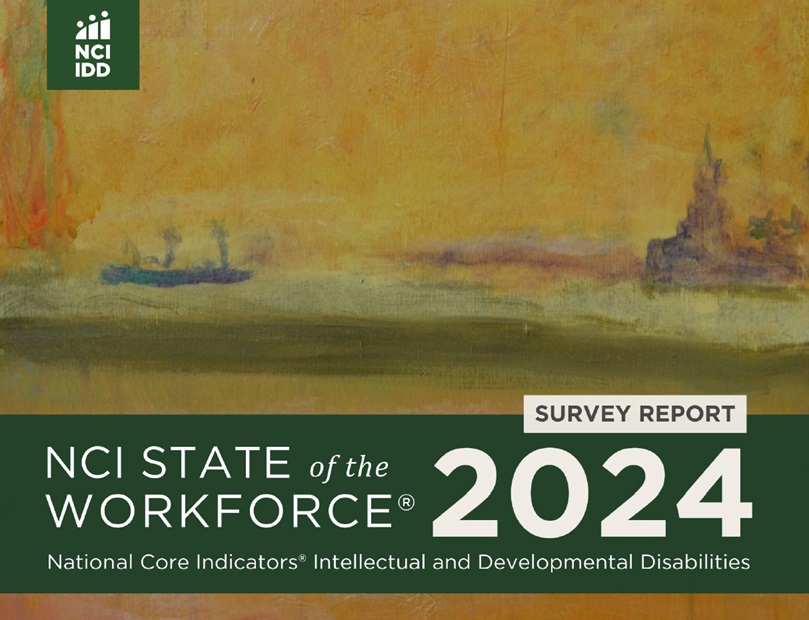
Click here to download:
NCI State of the Workforce in 2024 Survey Report
NCI State of the Workforce in 2024: INFOGRAPHIC
Cover art by Kathleen Wells
Learn more about Wells’ work at https://vinfen.org/services/gateway-arts/
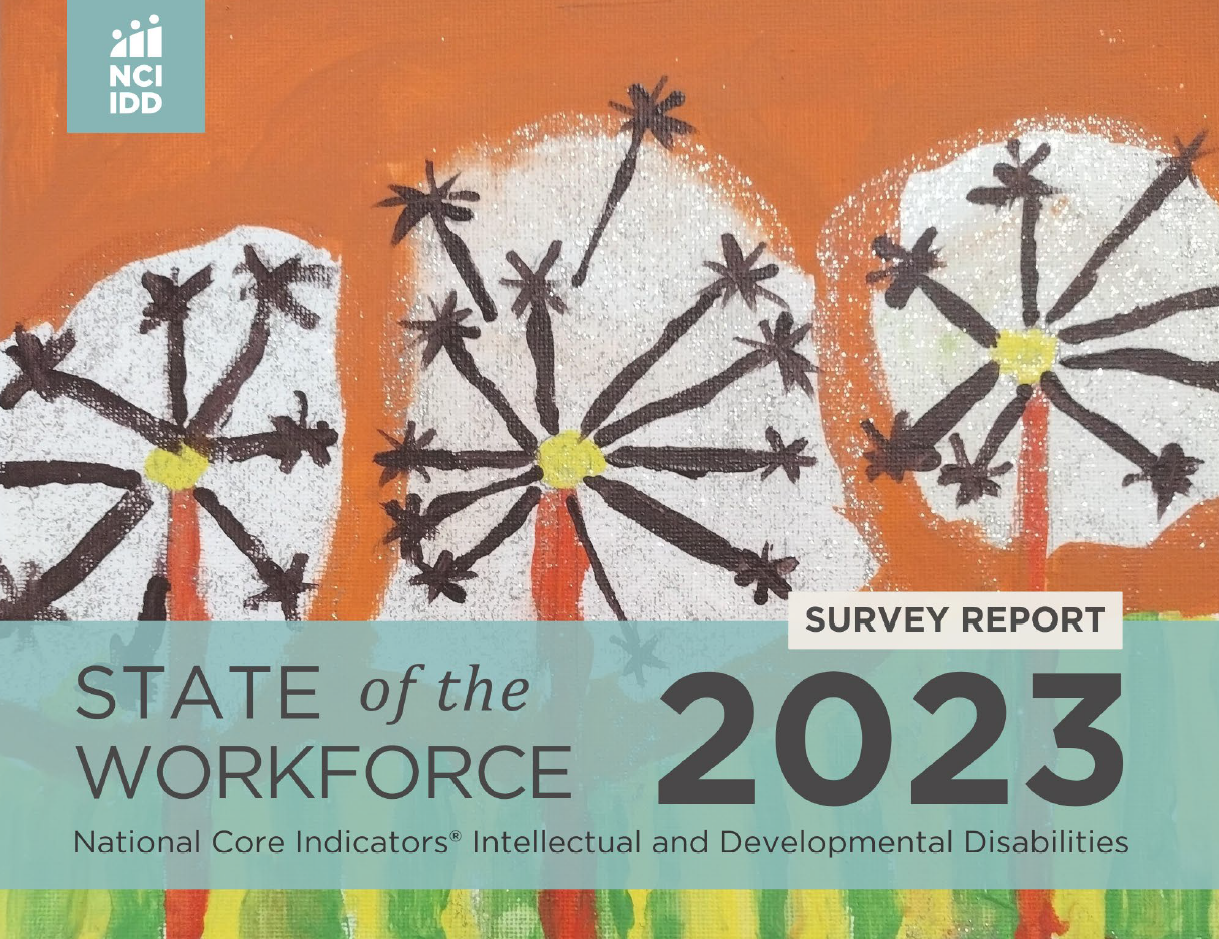
Click here to download:
NCI State of the Workforce in 2023 Survey Report
NCI State of the Workforce in 2023: INFOGRAPHIC
Cover art by Veronica Hernandez
Learn more about Hernandez’s work at lifespanservices.org
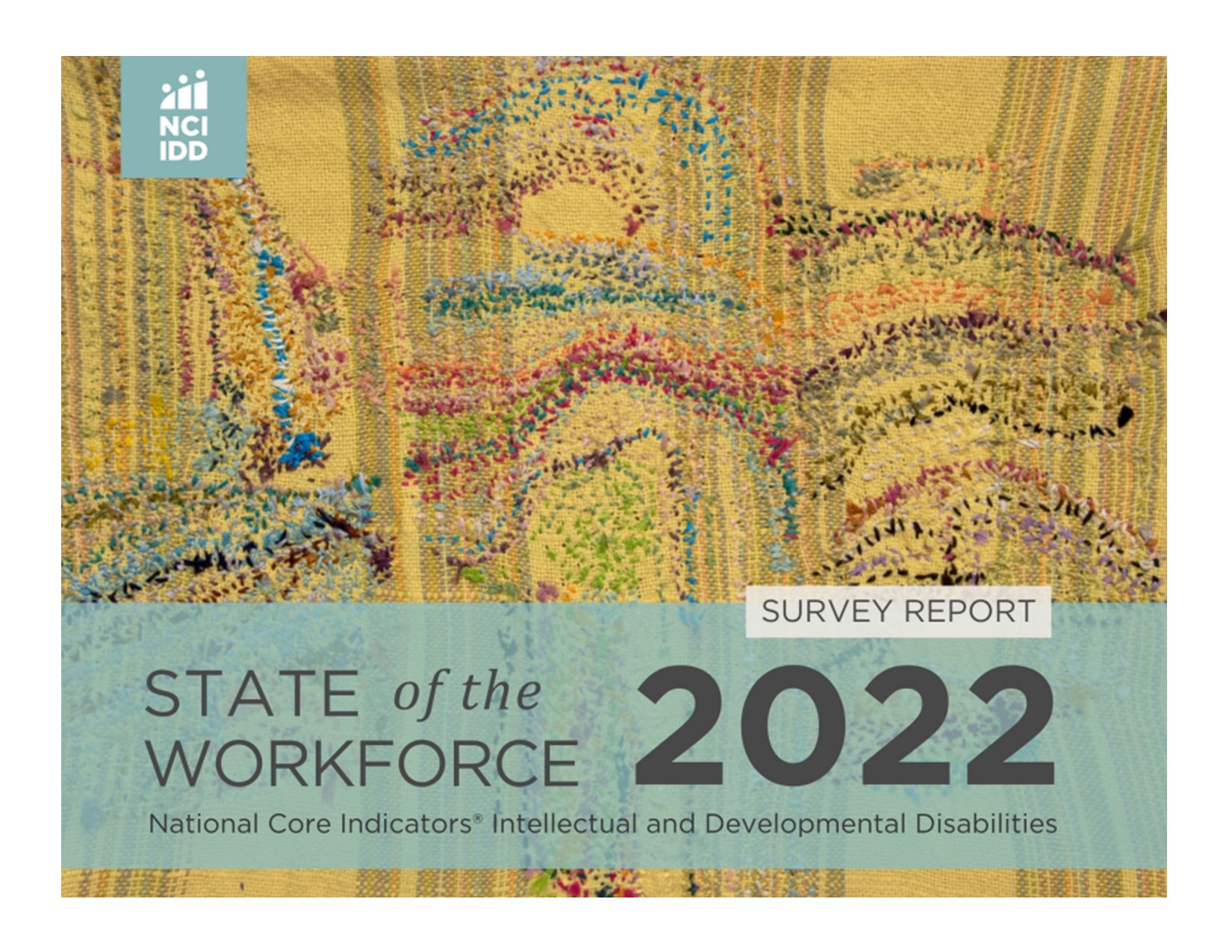
State of the Workforce in 2022 Survey Report
State of the Workforce in 2022 Survey Report INFOGRAPHIC
Cover art by Sidney Perry
Learn more about Perry’s work at https://gatewayarts.org/artists/sidney-perry/
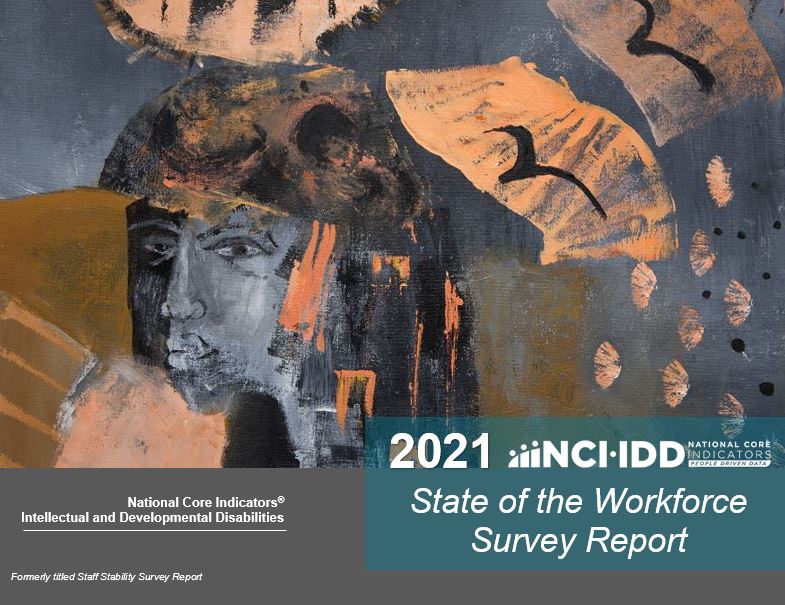
State of the Workforce in 2021 Survey Report
State of the Workforce in 2021 Survey Report INFOGRAPHIC
For reports from other survey years, check out the Report Library.
A total of 26 states plus the District of Columbia administered the 2020 NCI-IDD State of the Workforce Survey/ Staff Stability Survey. All told, 2,987 provider agencies are included in this report.
2020 NCI-IDD Staff Stability Survey Report
2020 NCI-IDD Staff Stability Survey Report – COVID-19 SUPPLEMENT
2020 NCI-IDD Staff Stability Survey Report INFOGRAPHIC
For reports from other survey years, check out the Report Library.
Data for Action
Last updated: April 23rd, 2025
This brief examines data from National Core Indicators Intellectual and Developmental Disabilities (NCI-IDD) In-Person Survey (IPS) and National Core Indicators Aging and Disabilities (NCI-AD) Adult Consumer Survey (ACS) to shed light on the populations of people self-directing their supports and their experience of self-direction. These two self-direction data sets show that there are notable differences both among each survey population and between NCI-AD and NCI-IDD respondents. These include differences in demographics (e.g., diagnosis, race and ethnicity, level of disability) of those who use self-direction and differences in their experience of self-direction. The experiential differences also vary by personal characteristics, such as mode of communication and age. This brief concludes with recommendations for public managers as they consider how to expand service users’ access to self-direction.
Person-centered practices (PCP) are considered a best practice for developing person-centered service plans. However, there is not enough research on how PCP impact outcomes for service users. National Core Indicators-Intellectual and Developmental Disabilities (NCI-IDD) analyzed data from over 22,000 adults with intellectual and developmental disabilities (I/DD) using state-funded services who responded to the 2018-19 NCI-IDD In-Person Survey. We used multi-level regression to look at user experience with PCP & outcomes.
Key takeaways
When controlling for other factors:
- People who choose the services they get as part of their service plan have more choice about life decisions (21% higher Life Decisions scale scores)
- People who can contact their case manager when they want to are more satisfied with their community inclusion (27% higher Satisfaction with Community Inclusion scale)
- People who say their case manager asks them what is important to them are more likely to say that services help person to have a good life (3.6 times higher odds)
- People who say their service plan includes what is important to them are more likely to describe their health as very good or excellent (1.5 times higher odds)
- Person-centered practices among Case Managers have a relatively small relationship with the Everyday Choices scale. This may be due, at least in part, to the fact that ability to make everyday decisions is more influenced by the paid staff who support people than by the Case Managers and service plans.
These results provide strong evidence that experiencing person-centered planning and practices is consistently associated with better outcomes. Participating in developing service plans was positively associated with all five outcomes. Meaningful person-centered planning is a resource intensive effort, and this research has implications for training and assessment of person-centered practices in case management, as well as monitoring appropriate case load size for case managers.
If you have any questions or feedback on the resources, please reach out to ldubois@hsri.org
This joint NCI and NCAPPS data brief presents a hypothetical case study of how states can use National Core Indicator (NCI) data (NCI-IDD and NCI-AD) to look at system-level person-centered planning and practices and get an idea of statewide system alignment with the HCBS Settings Rule.
According to the results of the 2021-2022 Adult Family Survey (AFS), about 1 in 2 respondents to the AFS reported they or someone else in the family was paid by the IDD agency to provide services to their family member. Caregiving can result in added stress for the caregiver, loss of income, and reduced health and quality of life. During the pandemic, these stresses increased. Paying family caregivers recognizes the key role they play in supporting their family member.
- Without the advantage of education and training beyond high school, the ability of people with IDD to escape poverty and find employment is diminished.
- Though the numbers of people who were enrolled in post-secondary education in the NCI IPS for 2020-2021 was very small, the availability of these opportunities is growing.
- According to the results 2020-2021 In-Person Survey (IPS), only slightly more than 3.2% of respondents with intellectual and developmental disabilities (IDD) aged 18-25 were enrolled in a college or university.
- The benefits of vacation are abundant and well-documented, especially for those with IDD, whose social networks and opportunities are often more limited as a result of the enforced uniformity of their daily lives.
- Vacations add to our quality of life and expand our horizons.
- In 2021, while just 44% of the general population vacationed, only one in four people with IDD reported taking a break – a number that ranged by state from 6% to 39%.
COVID-19 is continuing to disrupt the lives of families around the country but poses particular challenges to families who have a child or adult with IDD living at home. Check out this data highlight NCI-IDD Adult Family Survey data from the COVID Supplement implemented in 2020-21. These data demonstrate the impact of COVD-19 on families who have a family member receiving state DD services and living at home.
Disclaimer: Data spotlights include content posted on social media since 2023. The images and text may include information that does not reflect the most recent numbers.

Did you know that the majority of people with intellectual and developmental disabilities who receive state DD system services have a conservatorship or guardianship in place? Across the National Core Indicators IDD surveys from 2021-22, 1 out of every 2 respondents have a partial or full guardian.
So why does this matter? A guardianship, or conservatorship as it is sometimes called, is a legal contact that gives decision-making rights over a person to another individual. This can include decisions about finances and health care, as well as whether to marry and raise a family. In other words, people under guardianship do not have the right to make their own decisions about important matters. Because many people with disabilities have guardians, many people with disability do not have the right to make many of their own decisions.


One promising alternative to guardianship is called Supported Decision-Making, or SDM. According to the ACLU, “SDM is a tool that allows people with disabilities to retain their decision-making capacity by choosing supporters to help them make choices. A person using SDM selects trusted advisors, such as friends, family members, or professionals, to 3 serve as supporters. The supporters agree to help the person with a disability understand, consider, and communicate decisions, giving the person with a disability the tools to make her own, informed, decisions.” As many experts have noted, SDM is exactly like how most people make decisions – by asking trusted friends and family for advice.
Currently, 11 states and the District of Columbia have passed legislation making supported decision- making a legally enforceable arrangement. But many families don’t know about these alternatives. Among the 11,803 respondents to the 2021-2022 NCI Adult Family Survey, 51% had learned about alternatives to guardianship; among the 7,783 respondents to the 2021-2022 NCI Child Family Survey, just 21% had learned about alternatives to guardianship. For more information about our family surveys, check out the At a Glance

It’s Direct Support Professionals Recognition Week #DSPRW2023, so we are featuring some of the most recent findings from our annual State of the Workforce survey. Every year, we survey DSP provider agencies across the nation to learn about the characteristics of DSPs, average wages and benefits, turnover and tenure. In 2021-2022, we heard back from nearly 4,000 provider agencies in 29 states. Some of the key findings include:
- Almost 3/4ths of DSPs are females, and 4 out of 10 DSPs are black/African American.
- Median hourly wage is $14.50/hr
- The majority of agencies (74%) offered paid time and health insurance to some or all DSPs (60%)
- The average turnover ratio was 43%. This means that 43% of the people employed as DSPs on Jan 1 2021 left the agencies employing them before Dec 31 2021.
Of note, the highest rates of turnover were observed for DSPs who provided exclusively residential supports. This group of providers also has, on average, the lowest wages.

Why does high turnover of DSPs matter?
High turnover impacts not only the DSPs who stay, but has a major impact on the quality of services that people receive. On the 2021-2022 NCI-IDD In-Person Survey and the NCI-AD Adult Consumer Survey, we asked people who use long-term services and supports if they felt their staff changed too often. Among people with IDD, 40% said their staff change too often, and among people with physical disabilities and older adults, 25% said their staff changed too often.


Among those who felt their staff changed too much, there were more likely to report:
- They often feel lonely
- They are not able to do things outside the home as much as they want to
- They never or only sometimes have transportation when they want to do something outsdie the home for fun
They were less likely to report:
- They have enough help for self-care and daily activities
- They are satisfied with staff
- Their services help them to live a good life


People who use Medicaid funded HCBS have a right to a person-centered service plan. Several NCI-IDD outcomes examine person-centered planning and service coordination. Among people who responded to the 2022-23 NCI-IDD survey:
- 93% say their service plan includes things that are important to them
- 75% say they helped make their service plan
- 86% say staff do things the way they want them done
- 17% use a self-directed supports option. Among those, 15% of people say they mostly make the decisions about services that are self-directed and 40% say they have input and family/friends help with decisions.
These data highlight areas of opportunity to strengthen methods for person-centered planning and enhancing opportunities for self-direction.


July is #disabilitypride month, and we are putting a spotlight on choice and decision-making. People with intellectual and developmental disabilities (IDD) want to be able to make choices about their lives. Unfortunately, the reality is that for many people receiving services from their state DD system, they are not always given the chance to make choices about their lives. Or, they may have the chance to make some choices but not others. In the 2022-23 NCI-IDD survey, we learned that:
- 46% of people chose their regular day activities, and another 37% had some input
- 24% of people chose the place they live, and another 31% had some input
- 23% of people chose the people they live with, and another 20% had some input
There are several reasons that people with IDD may not get the opportunity to make choices in their lives. According to the 2022-23 NCI-IDD, 47% of people with IDD have a guardian. Guardians are in change of making decisions on behalf of people with IDD.
One promising alternative to guardianship is called supported decision-making. This practice recognizes the idea that everyone seeks support and advice from our family, friends, or peers about decisions we have to make, whether we have a disability or not.

What does NCI-IDD tell us about the rights of people with IDD? We ask several questions in our surveys about rights and respect, and the results are quite mixed. For example, most people with IDD say others let them know before entering their bedroom (80%). However, just 3 in 5 people with IDD can lock their bedroom door, and fewer than half (47%) can stay home if others in the house go somewhere. While a small percentage of respondents tell us that there are rules about using the phone or internet (16%), more than 1 in 4 people with IDD (27%) say there are rules about having friends or visitors in the home.


Research consistently demonstrates that people with IDD need more support to have meaningful relationships. Looking at 2022-23 NCI-IDD data related to access to community and broader feelings of inclusion:
- More than 2 out of every 3 respondents say they have transportation, can do things in the community as often as they want, and have friends they can meet with.
- Further, 3 out of every 4 participants have a goal to increase participation in their community, but just 1 out of every 4 participants take part in groups, organizations or communities.
- Just over half of participants (56%) have a goal related to relationships, and nearly half of participants (44%) want help making or keeping in contact with friends.
These data suggest that there is still room to improve community engagement and support meaningful relationships for people with IDD. It is important for LTSS systems to identify barriers to community access and participation.


From July 2022-June 2023, HSRI, NASDDDS, and our state partners worked to collect data from more than 25,000 people with IDD who use state-funded DD services. We asked them to tell us about their involvement in the community and their relationships:
- 17% have gone to a self-advocacy group meeting, conference or event
- 25% take part in groups, organizations or communities (in-person or virtually)
- 37% want to be a part of more groups in the community
- 44% say yes, they want help to meet new people, make new friends, or keep in contact with friends
People with IDD want the same opportunities to participate in their communities as peers without disabilities. These data show us that across many states, many people with IDD want to be more involved in their communities and want help to connect with peers.

People with IDD want to have meaningful relationships with others. For many, this can mean the ability to go on dates, get married, or raise a family. In 2022-23, HSRI, NASDDDS, and our state partners gathered data from people with IDD who use state funded DD services about their relationships. Among the 25,000 people with IDD we surveyed:
- 1% are married and 2% have been married in the past
- Among those who are unmarried, 77% can date without restrictions
- 4% are parents
Many people with IDD receive supplemental security income, or SSI. In 2025, the maximum monthly SSI payment for an individual is $967, while for a couple it is $1,450. This is commonly referred to as the “SSI marriage penalty.” In many states, eligibility for Medicaid is tied to eligibility for SSI, and losing SSI eligibility would mean losing access to essential healthcare.

Home and community-based services are based on the idea that people using services will have better access to their communities and more opportunities to develop meaningful connections to others if they live in communities with their peers, instead of living in institutional settings.
Using the NCI-IDD 2022-23 data from more than 25,000 adults with IDD, we know that:
- 1 in 4 people are part of groups, organizations, or communities
- 1 in 3 people want to be part of more groups in the community
- Almost 3 in 4 people have a goal to increase community participation in their services plan
These data underscore the importance of finding ways to enhance community engagement for people with IDD.

We also looked more closely at how people with IDD describe their relationships. Using the NCI-IDD 2022-23 data from more than 25,000 adults with IDD, we know that:
- More than 2 in 3 people can meet with their friends when they want
- About 2 in 5 people want help to keep or maintain relationships
- Almost 3 in 5 people have a goal in increase friendship in their service plan
As with the data on community participation, these data highlight that many people with IDD want support to make or maintain connections to their peers. As our country engages in conversations about enhancing Medicaid, we encourage partners to use these data to inform decision making and future planning for services.


Decades of research have demonstrated that people with disabilities, and especially people with IDD, experience poorer access to and quality of healthcare, and ultimately poorer health outcomes, than peers with disabilities. Almost one year ago, the NIH designated people with disabilities as a population that experiences health disparities. We can examine some of these disparities in NCI-IDD data.
Many people with IDD qualify for Medicaid, and among the NCI-IDD respondents, 47% receive Medicare. While state and federal eligibility requirements allow many people with disabilities to qualify for public health insurance, access to healthcare is still not a guarantee. In the 2022-23 NCI-IDD survey:
- 83% of people had an annual physical in the past year
- 76% had a routine dental exam in the past year
- 53% had a vision screening in the past year
- 72% of women (50 years and older) had a mammogram in the past 2 years
- 49% of women (21 years and older) had a pap test in the past 3 years
Lack of access to routine medical care can cause people to have more significant adverse health events. In the NCI-IDD data, we see that 24% of people with IDD went to the emergency room to get care for themselves in the past 12 months.
Further, when people with IDD seek healthcare, they sometimes find healthcare professionals who don’t have much experience working with people with disabilities. For example, just 63% of respondents to the Adult Family Survey say that primary care doctors always understand their family member’s needs related to their IDD.


In 2022-23, we surveyed more than 25,000 adults with IDD using state-funded developmental disability systems. Using administrative data and case management records, we found that about 1 in 4 people with IDD have an anxiety disorder, 1 in 5 have a mood disorder, and almost 1 in 10 have a psychotic disorder.
Some people may have more than one mental health or behavioral health condition. Accessing mental health services can often be challenging, but the obstacles for people with IDD can be significant. We also know that the use of psychotropic medications to manage mental and behavioral health conditions is very high among people with IDD. In fact, in 2022-23, more than half of NCI-IDD respondents took at least one medication for mental or behavioral health conditions.

According to Mental Health America, there are 340 individuals for every one mental health provider in the US. There are many obstacles to accessing mental health providers for people with disabilities and older adults, including finding a provider that is “in-network” with insurance, has availability for new clients, and has knowledge and experience working with people with disabilities.
Using the 2023-24 NCI-IDD Family Surveys, we can look at whether children and adults with IDD using state-funded DD services are always able to get mental or behavioral health supports when needed. Across the three different surveys, we see a large spread across states (as shown in the figure here).
The data shows us that overall, respondents to the NCI-IDD Family Guardian Survey (FGS) have higher rates of saying their family member can always get mental or behavioral health supports. Meanwhile, those whose family members with IDD live with them (Adult Family Survey (AFS) and Child Family Survey (CFS) respondents) have lower rates of always getting mental health supports.
As we look at ways to enhance access to services and supports for people with mental health needs, it’s important to consider the needs of the disability community.

Employment is a universal yardstick; governments measure the strength of their economies by employment metrics, and adults measure their success and, in many instances, their self-worth, by their jobs. Further, employment is a strong predictor of other outcomes, including community participation, relationships, and health. In the United States, while rates of employment are relatively high, the same is not true for people with disabilities.
For many years, people with IDD worked in sheltered workshops, which weren’t integrated into the community and paid little to no wages. While there has been great progress in moving from sheltered workshops to paid jobs in the community, rates of employment among people with IDD are still low.
In the 2022-23 NCI-IDD survey:
• 17% of respondents have a paid community job
• 44% of those who do not have a paid community job want one
• 25% of all respondents have a goal for employment in their service plan
Among those who have a paid community job, they tend to work limited hours at very low wages. If people with IDD are going to thrive in their communities, we must create more opportunities for competitive integrated employment (CIE).

Continuing our #NDEAM data spotlights, we also took a closer look at how employment outcomes differ across age groups for people with IDD.
- Among 18–22-year-olds with IDD who participated in the 2022-23 NCI-IDD survey, 15% have a paid job in the community, but 53% don’t work and want a job in the community.
- Among 22–34-year-olds with IDD, 22% have a paid job in the community, and 42% don’t work but want a job in the community.
- Among 35–54-year-olds with IDD, 19% have a paid job in the community, and 38% don’t work but want a paid job in the community.
Across all of these age groups, we see much higher rates of people with IDD who want to work than rates of people with IDD who do work. According to the Center for Research on Disability, the employment rate for all people with disabilities in 2022 was 44.5%, which is more than double the rate among people with IDD regardless of age group. This data underscores the importance of having policies to strengthen state practices around employment for people with IDD. Examples include enhanced supports for employment, employer incentives, and case manager training.


There are many barriers to having a paid job in the community for people with IDD. One of the biggest barriers we hear about is transportation. When we look more closely at those 18-22 who have access to transportation, we see rates of having a paid job jump to 26%. When we look at people with IDD aged 23-34, we see a similar story as with their younger peers. Among those who have access to transportation, 34% have a paid job in the community.
Having access to transportation is not just important for employment, but increases opportunities to be part of their communities in all different ways.
As we think about how to improve employment for people with disabilities for #NDEAM, it’s important to think holistically about the different supports needed to have steady, paid work.


As #NDEAM comes to a close, we take a closer look at the connection between service plans and employment. A service plan is a document that outlines the services and supports needed to meet an individual’s life goals and their needs.
- Among those with IDD aged 23-34 who have a goal for employment in their service plan, more than 4 out of 10 (44%) have a paid job in the community.
- Among those aged 35-54 who have a goal in their service plan for employment, nearly half (46%) have a paid job in the community. This rate is more than double the average among all people with IDD aged 35-54.
We know that person-centered planning is a key ingredient to having high quality services and supports. This data shows a clear connection between having a job and having a goal for employment in their service plan.

Every year in the NCI survey, HSRI, NASDDDS, and our state partners collect data to learn whether people with IDD go to college or university. In 2022-23, we surveyed more than 25,000 people with IDD who use state-funded DD services. Among those who are 18-25 years old:
• 21% are enrolled in high school
• 3% are in a vocational school or certificate program
• 4% are enrolled in college
Although these numbers are small, the opportunities to pursue college are increasing for people with IDD, in large part because of growing numbers of college programs aimed at supporting students with IDD. Think College reports that federal grants to states have created a pathway for almost 5,000 college students with IDD to enroll in college. This can be an important steppingstone to expanded employment opportunities.


In 2023-24, 9 out of 10 Adult Family Survey respondents say the services and supports have made a positive difference in the life of their family member with IDD. However, just 73% say their family gets all the supports and services it needs, and 41% are always satisfied with the services their family member currently receives.


Similar to the AFS, almost all Child Family Survey respondents (91%) say that these services make a positive difference in the life of their child. However, there’s room for improvement: just 33% of respondents are always satisfied with the services their child currently receives. Just 1 in 3 families say that services change when their family’s needs change, and only 40% of families say their child can always get mental or behavioral health supports when needed.


Once again, Family Guardian Survey respondents largely report that services and supports have made a positive difference in the life of their family member with IDD. At the same time, 2 in 5 respondents (42%) say their family member’s support workers change too often, and just 40% say support workers always have the right information and skills to meet family’s needs.

Altogether, these data show that the Medicaid-funded services from state DD agencies are important to help people with IDD to live a good life, AND the quality and availability of supports can be improved. In particular, service plans need to include all of the services and supports families need, and there needs to be better care coordination to ensure that families are getting supports that are flexible and responsive to changing family circumstances.
NCI team members recently published the article “Effects of person-centred planning and practices on the health and well-being of adults with intellectual and developmental disabilities: a multilevel analysis of linked administrative and survey data.” in the Journal of Intellectual Disability Research. (https://onlinelibrary.wiley.com/doi/10.1111/jir.13015)
Here is an infographic illustrating the major findings of the paper.
Here below is a plain-language summary of what the article found!
Background
Person-centered practices (PCP) are considered a best practice for developing person-centered service plans. PCP in service planning are driven by service users’:
- Individual preferences
- Needs
- Priorities
US policies require state systems to adopt PCP. These policies apply to any home and community-based service setting. However, there is not enough research on how PCP impact outcomes for service users. This study aims to address this gap. This will be done by studying the relationship between PCP and outcomes for adults with intellectual and developmental disabilities (I/DD) who use state-funded services.
Methods
Data for this study comes from the 2018-19 National Core Indicators® In-Person Survey (NCI). The NCI links survey responses with state records. This study includes a sample of 22,000 adults with I/DD getting services from 37 states. We used multi-level regression to look at user experience with PCP & outcomes.
We studied 5 outcome measures:
- Choice and control over life decisions
- Everyday choices
- Satisfaction with community inclusion
- Self-reported health
- Whether a person feels their services are helping them to have a good life
We studied 4 measures of PCP:
- Does your case manager/service coordinator ask what you want?
- Are you able to contact your case manager/service coordinator when you want to?
- Were you able to choose the services that you get as part of your service plan?
- Does your service plan include things that are important to you?
Results and Future Directions
This study adds to the evidence of PCP as a best practice. This study also shows the value of linking survey data and state records to have a better picture of person-centered practices. Some of the call to action of this study are for stronger policy and training for PCP in state DD systems. This should include paid support staff as well as case managers.
There is a strong relationship between better outcomes and the PCP measures. In particular, participating in developing service plans was positively associated with all five outcomes.
In response to the COVID-19 pandemic, NCI-IDD added a state-optional COVID-19 Supplement to all NCI Surveys. The COVID-19 Supplement is intended to support the understanding of the experience of people with disabilities and their families at the beginning of the COVID-19 pandemic, and their interactions with services during that time. Data were collected between July 1, 2020 and June 30, 2021. This Special Edition Report shows individual state and overall national outcomes for the NCI-IDD COVID-19 Supplement questions.
These reports, designed together with self-advocates, highlight topic-specific data in an accessible, easy-to-read format.
2020-21 National In-Person Survey User Friendly Report: Case Management and Staff
2020-21 National In-Person Survey User Friendly Report: Choice and Satisfaction
2020-21 National In-Person Survey User Friendly Report: Employment
2020-21 National In-Person Survey User Friendly Report: Health Access
2020-21 National In-Person Survey User Friendly Report: Rights, Privacy and Safety
2020-21 National In-Person Survey User Friendly Report: Service Plan
2020-21 National In-Person Survey User Friendly Report: Using Internet, Cell Phone, or Smart Phone
2020-21 National In-Person Survey User Friendly Report: Wellness
2020-21 National In-Person Survey User Friendly Report: Community Participation
2020-21 National Adult Family User Friendly Report: Access and Delivery
2020-21 National Adult Family User Friendly Report: Case Management and Support Staff
2020-21 National Adult Family User Friendly Report: Community Participation
2020-21 National Adult Family User Friendly Report: Crisis and Reporting
2020-21 National Adult Family User Friendly Report: Information and Planning
2020-21 National Family/Guardian User Friendly Report: Access and Delivery of Services and Supports
2020-21 National Family/Guardian User Friendly Report: Case Management and Support Staff
2020-21 National Family/Guardian User Friendly Report: Community Participation
2020-21 National Family/Guardian User Friendly Report: Crisis and Reporting
2020-21 National Family/Guardian User Friendly Report: Information and Planning
2020-21 National Child Family Survey User Friendly Report: Access and Delivery
2020-21 National Child Family Survey User Friendly Report: Case Management and Support Staff
2020-21 National Child Family Survey User Friendly Report: Community Participation
2020-21 National Child Family Survey User Friendly Report: Crisis and Reporting
2020-21 National Child Family Survey User Friendly Report: Information and Planning